Goldendoodle generations explained. F1, F1B, F2B and more
If you have read three breeder websites and still cannot keep F1, F1B and F2B straight, this is the page that fixes that. Each generation has a different mix of Golden Retriever and Poodle, and the mix changes coat, shedding, allergy compatibility, and temperament more than most new owners realize.
The naming convention in 30 seconds
The letter F means filial generation. The number is which generation of the cross. The letter B means a backcross to the Poodle, since Poodles are the source of the curly low shed coat.
- F1 = Golden Retriever × Poodle. First cross.
- F1B = F1 × Poodle. Backcross.
- F1BB = F1B × Poodle. Double backcross.
- F2 = F1 × F1.
- F2B = F2 × Poodle, or F1 × F1B.
- F3 or multigen = any cross past F2.
Higher Poodle percentage usually means curlier coat and lower shedding. That is the headline most breeders skip.
F1 Goldendoodle
50% Golden Retriever, 50% Poodle. The classic doodle. The most variability in the litter, since you can land anywhere on the Golden-to-Poodle coat spectrum. Some F1 puppies have a flat or wavy coat that sheds lightly. Others come out curly and low shed.
Best for: families with no major allergies who want the most Golden Retriever personality. Be ready to groom either way, but the daily brushing demand can be lower than F1B if the coat lands wavy.
F1B Goldendoodle
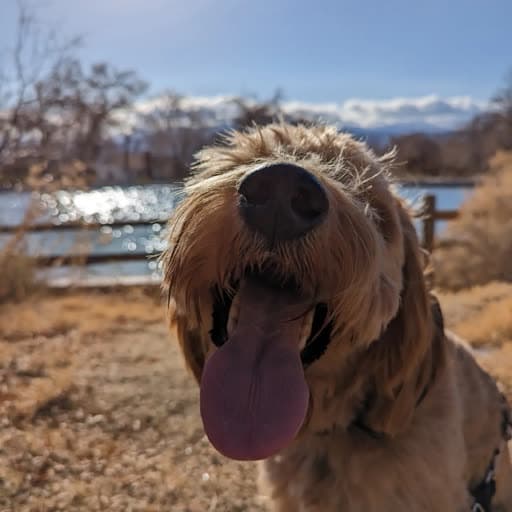
75% Poodle, 25% Golden Retriever. Created by breeding an F1 back to a Poodle. This is what Mango is. F1Bs are the sweet spot for many allergy households. Coat is reliably curlier and lower shedding than F1, while still keeping plenty of the Golden Retriever temperament.
Best for: mild to moderate allergy households, owners who want lower shedding without going full Poodle, anyone chasing the teddy bear look. We dive deeper on the look itself in our Teddy Bear Goldendoodle guide.
Heads up: curlier coats need more grooming. Plan on a slicker brush and a daily three minute brush habit, plus a full professional groom every six to eight weeks.
F1BB Goldendoodle
87.5% Poodle, 12.5% Golden Retriever. Created by breeding an F1B back to another Poodle. Almost all Poodle in coat behavior. Tightly curled, very low shedding, often the choice for severe allergy households who still want some Golden personality.
Best for: severe allergy households, owners who don't mind a coat that requires the most maintenance. See our are Goldendoodles really hypoallergenic guide for what the research actually says.
F2 Goldendoodle
Two F1 Goldendoodles bred together. Genetics get unpredictable. You can land on Golden Retriever-heavy traits even though both parents are themselves crosses. F2 litters are not as common with reputable breeders for this reason.
Best for: not many households. Hard to predict shedding, hard to predict size. We tend to recommend skipping F2 unless the breeder has a long track record with the specific line.
F2B Goldendoodle
62.5% to 75% Poodle, depending on the cross. Created by breeding an F2 back to a Poodle, or an F1 to an F1B. More predictable than F2, and increasingly the generation breeders favor for consistent low shed coats.
Best for: allergy households who want a doodle but have already had a coat surprise with an F1.
Multigen Goldendoodle
Anything past F2. Multigen breeders are typically the most experienced, with years of pedigree data. The best multigen breeders can predict size, color, coat type and temperament with high accuracy because they have generations of records.
Best for: families who want a specific look or coat trait, like very low shed, a particular color, or a small size, and are willing to pay a premium for a more predictable outcome.
Generation comparison at a glance
- F1: 50% Poodle. Variable coat. Mid shedding.
- F1B: 75% Poodle. Curlier. Lower shedding. Most common allergy pick.
- F1BB: 87.5% Poodle. Very curly. Very low shedding.
- F2: Variable. Hard to predict.
- F2B: 62.5 to 75% Poodle. Predictable low shed.
- Multigen: Most predictable. Most expensive.
| Poodle percent | Coat | Best for | |
|---|---|---|---|
| F1 | 50 percent | Variable, often wavy | Most Golden personality, no major allergies |
| F1B | 75 percent | Curlier, lower shedding | Mild allergies, the teddy bear look |
| F1BB | 87.5 percent | Tightly curled | Severe allergies, willing to groom heavily |
| F2 | 50 percent | Highly variable | Most owners should skip unless breeder has long track record |
| F2B | 62.5 to 75 percent | Predictable low shed | Allergy households who had a coat surprise with an F1 |
| Multigen | F3 plus | Most predictable | Specific look, color, or size with willingness to pay premium |
Which generation should you pick?
A few decision rules:
- No allergies, want the classic Golden look: F1. Cheaper, more variability, but you might luck into a wavy coat that grooms easier.
- Mild allergies, want the teddy bear look: F1B or F2B. Best balance of doodle personality and low shed.
- Severe allergies: F1BB or multigen with a documented coat history.
- Want predictable size or color: multigen from a specialty breeder.
What to ask the breeder
Whatever generation you pick, these questions separate good breeders from bad:
- What is the exact generation, and can I see the pedigree?
- What is the coat type of both parents?
- Have any siblings of this litter been DNA tested at Embark or similar?
- What size do you predict this puppy will be at adulthood?
- Can I see updated OFA health clearances for both parents? Our Goldendoodle health problems guide walks through what the OFA scoring actually catches.
A breeder who answers these clearly is the breeder who delivers the coat and temperament they advertise. Our how to spot a reputable Goldendoodle breeder guide goes deeper on contracts and red flags. For full puppy buying steps, including what to do in week one, see our Goldendoodle puppy guide.