Goldendoodle photography tips
Mango is a working content creator with a quarter million followers across TikTok, Instagram, YouTube, and Facebook. Most of the photos and reels you see were shot on an iPhone, by one person, with a treat and 90 seconds of patience. Here is the actual workflow that produces clean, scroll stopping doodle photos every time.
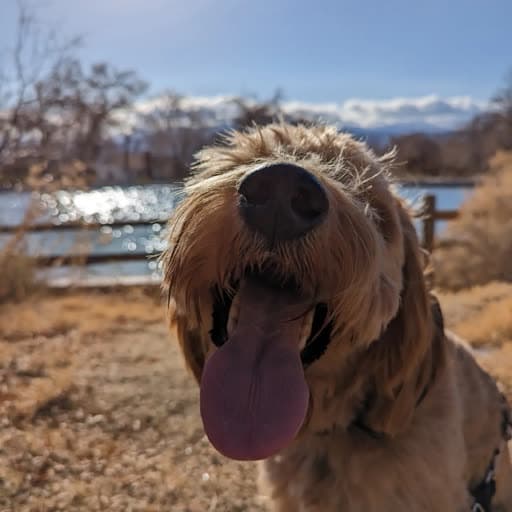
Why Goldendoodles photograph well (and where it goes wrong)
A Goldendoodle is a photographer's dream and a photographer's nightmare in the same animal. The fluff coat catches light beautifully, the eyes are big and expressive, and the natural expressions are warm. The catch is that a curly cream coat is one of the hardest subjects in dog photography. The detail in the curls disappears in flat midday light. The cream goes blown out in direct sun. And the dark eyes against a light face confuse most auto exposure systems.
The fix is not a better camera. The fix is light, distance, and timing. A 5 year old iPhone with the right setup will out shoot a $3,000 mirrorless with the wrong setup. Every tip in this guide is built around that principle.
Lighting: the one thing that matters
If you only learn one thing from this guide, learn light. Every other tip is a multiplier on top of light. Here is the priority order for shooting a Goldendoodle:
- Golden hour outdoors. The first hour after sunrise and the last hour before sunset. The light is warm, low angle, and forgiving. Cream coats glow. Apricot coats look amber. Chocolate coats keep their depth.
- Open shade outdoors. The shadow side of a building or under an awning on a bright day. Soft, even, no harsh shadows. Best second option after golden hour.
- Window light indoors. Place the dog 4 to 6 feet from a large window with the light hitting the side of the face. North facing windows give the cleanest, most flattering light. South facing in midday is too harsh.
- Overcast outdoors. A cloudy day is a giant softbox. The shadows are minimal, the colors are muted, and the dog will photograph well from any angle.
- Avoid: noon sun, mixed light (window plus lamp), and on camera flash. All three crush the curl detail and produce harsh shadows under the eyes.
Camera and phone settings that work
You do not need a real camera to make a Goldendoodle photo work. Here is the iPhone setup we use for ninety percent of Mango's content:
- Lens: 1x for full body, 2x for headshots. Skip the ultra wide 0.5x. It distorts the muzzle and pushes the eyes apart.
- Exposure lock: Long press on the dog's face until you see AE/AF Lock. This stops the camera from re metering when the dog moves slightly.
- Exposure compensation: Drag the little sun icon down by half a stop on cream and apricot coats. This holds the curl detail and stops the coat from blowing out.
- Portrait mode: Use it for headshots in good light. Skip it indoors or in low light, where the edge detection on curls falls apart.
- Burst mode: Hold the shutter button for 2 to 3 seconds and pick the best frame. The window of natural expression is short.
- Live photo on: Lets you swap the key frame after the fact in case you got a blink.
For real cameras, the equivalents are a fixed 50mm or 85mm prime, an aperture between f/2.8 and f/4, ISO 400 or below in daylight, and shutter speed at 1/500 or faster to freeze any movement.
| Setting | Recommended | |
|---|---|---|
| Lens | 1x for body, 2x for face. Skip 0.5x | |
| Exposure lock | Long press on face | |
| Exposure compensation | -0.5 stop on cream coats | |
| Mode | Portrait for headshot, Photo for action | |
| Burst | Hold shutter 2 to 3 seconds | |
| Live photo | On (allows key frame swap) |
Getting natural expressions (the hard part)
Anyone can get a dog to look at the camera. Getting a relaxed expression on top of that look is the actual craft. The trick is that you want the dog's brain to be slightly engaged but not over aroused. Here are the tools, ranked.
- High value treat held above the lens. Soft, smelly, broken into pea sized pieces. Mango's go to is freeze dried liver. The treat is the focus point. Reward 1 in 4 takes to keep the engagement up.
- The release word. Mango's release word is "okay." We say it once, the head tilts, and the camera fires. Same word, same tone, every time. Our Goldendoodle training guide covers how to layer in cue words like this.
- The unfamiliar sound. A click, a whistle, or a soft kissy noise. Pulls a head tilt for half a second. Use sparingly because it stops working after the third take.
- The scent introduction. Hold a treat or a strong smelling toy off camera. The nose lifts, the eyes follow, you get the alert expression without the wide eyed fear that a squeaky toy produces.
- Avoid: yelling, squeaking aggressively, or extending the session past 5 minutes. The fastest way to lose a doodle's expression is to push past their patience. Quit while they are still up.
Common Goldendoodle photography mistakes
Most doodle photos fail for the same five reasons. Once you stop making these, your hit rate doubles overnight.
- Cluttered background. A doodle is a busy subject. Pair it with a busy background and you get visual noise. Pick a solid color, a single texture, or a soft natural setting and stick with it.
- Shooting from above. The most common dog photo angle is also the worst. Get on your knees, then on your stomach. Eye level or below. The dog looks bigger, the photo looks intentional.
- Motion blur. Shutter speed too slow plus a moving doodle equals a soft photo every time. Use burst mode in motion. Set the camera to a wider aperture if it is a real camera. Fix the light first.
- Pre groom shoot. A doodle in week 7 of an 8 week groom cycle photographs flat. Schedule the bath 24 to 48 hours before the session, not the morning of.
- One angle. A single composition limits you to one chance for a hero shot. Shoot the same setup from straight on, 45 degrees, profile, low angle, and overhead. One of those five will be the keeper.
Grooming prep for a photo shoot
A doodle's coat is the photo. Treat the grooming prep like the shot prep, because it is.
- 48 hours before: Full bath and blow out. Slicker brush the coat all the way down to skin. Trim feet, face, and sanitary. Nails clipped flush to the hair line. Our best shampoos for Goldendoodles guide covers the bath routine that prevents post bath frizz.
- 24 hours before: Light brush. Skip a second bath. Let the natural oils come back, which is what gives the coat its glow.
- Day of, one hour before: Spot brush the face, ears, and front feet. Wipe eye boogers with a soft damp cloth. Comb out any matts behind the ears.
- Day of, ten minutes before: One more pass on the head and face. Treat in your pocket, water bowl out of frame, and you are ready.
Shooting multi angle setups
One scene, multiple angles, lots of usable photos. This is how a single 15 minute session produces a week of social posts.
- Hero shot: Eye level, dog centered, treat above the lens. The portrait.
- Three quarter: 45 degree angle, slight tilt of the dog's head. Adds dimension.
- Profile: Side view. Use this to highlight the coat silhouette and the muzzle. Best in golden hour with the sun behind the dog.
- Low angle: Camera below eye level pointed up slightly. Makes the dog look bigger and the background cleaner.
- Detail: Close up of paws, eye, or coat texture. Adds visual variety to a carousel.
Social ready edits
The photo is done. Now you have 2 minutes to make it pop in the feed. Here is the edit pass we use on Mango's content, all on phone:
- Crop first. 4:5 portrait for Instagram, 9:16 for TikTok, 1:1 square for Facebook. Crop tight on the dog. Whitespace is for art galleries, not for feed.
- Exposure plus 5, brightness plus 5, contrast plus 10. Brings life to a slightly underexposed RAW. Skip if the photo is already bright.
- Warmth plus 3 to 7 on cream coats. The original sensor reads doodle cream as cool. Warming it up matches what the eye actually sees.
- Sharpness plus 10 on the face only. Use a brush mask if your editor supports it. A subtle sharpness bump on the eyes makes the whole frame pop.
- Skip filters. Heavy filters age fast and they crush curl detail. A clean edit travels further.
For brands looking to commission a photo or video shoot with Mango, the brief and rates live on work with Mango. The portfolio is on the gallery.
Quick FAQ
What is the best time of day to photograph a Goldendoodle? Golden hour. The first hour after sunrise and the last hour before sunset.
Phone or real camera? Phone is enough for ninety percent of doodle content. The light, the angle, and the treat matter more than the sensor.
How long should a session be? Four 5 minute sets with breaks. Quit while the dog is still up.
What is the easiest way to get an instant head tilt? An unfamiliar sound off camera, used once. Whistle, click, or a soft kissy noise. Works for half a second the first time and almost never on the third try.
Where can I see Mango's photo work? The full set lives on Mango's gallery with brand campaigns highlighted on the media kit.