Goldendoodle weight loss: how to safely slim down an overweight dog
Noticing your Goldendoodle looks a little rounder lately is not a reason to feel guilty. It happens gradually, it happens to most dogs at some point, and it is very fixable. The key is going about it the right way so the dog loses fat, keeps muscle, and does not spend six months acting like they are being starved. This guide covers how to know if your dog actually needs to lose weight, how much weight loss per week is realistic and safe, and the changes that make the biggest difference without turning mealtimes into a standoff.
Is your Goldendoodle actually overweight?
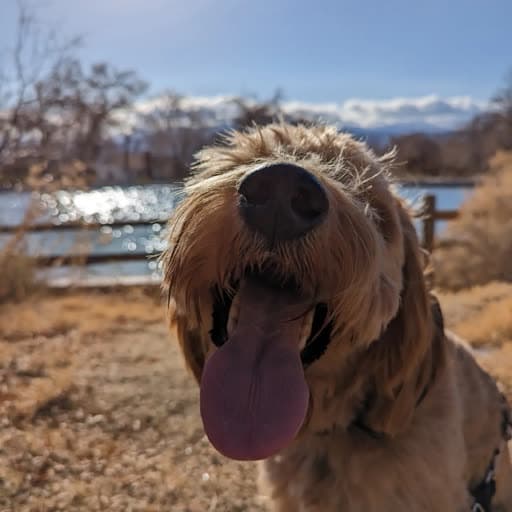
Fluffy coats make weight hard to eyeball. A Goldendoodle can carry significant extra weight and still look fine in photos. Three hands-on checks give you a much better read than looking alone.
The rib test is the most reliable. Run your fingers along your dog's ribcage with gentle pressure. You should be able to feel individual ribs without pressing hard. If you need to push firmly before you feel anything, the dog is carrying too much fat over the ribs. If ribs are immediately visible or sharp to the touch, the dog may be underweight.
The waist test is done from above. Look down at the dog while they are standing. Behind the ribcage, the body should narrow inward. That narrowing is the waist. A dog at healthy weight has a clear waist. A dog with no visible narrowing behind the ribs is overweight.
The tuck test is done from the side. A healthy dog has an abdomen that tucks upward behind the ribcage when viewed from the side. A belly that hangs level or sags downward is a sign of excess weight.
For a formal assessment, ask your vet to score your dog on the Body Condition Score (BCS) scale. Most vets use a 9-point scale. A score of 5 is ideal. Scores of 6 and 7 indicate overweight. Scores of 8 and 9 indicate obesity. A BCS check takes about two minutes at any wellness visit.
Why this matters more for Goldendoodles than some other breeds
Goldendoodles inherit above-average orthopedic risk from both parent breeds. Hip dysplasia and elbow dysplasia are common in Golden Retrievers and in Poodles. An overweight Goldendoodle puts more load on joints that are already predisposed to problems.
Research in dogs shows that even a small amount of extra weight accelerates the onset and progression of arthritis in dogs with hip dysplasia. A dog that might develop noticeable arthritis at age 9 or 10 at healthy weight could show symptoms at age 6 or 7 carrying extra pounds.
Beyond joints, overweight dogs have higher rates of heart disease, diabetes, and certain cancers. Life expectancy data in dogs consistently shows that lean dogs live longer than overweight dogs of the same breed.
Safe rate of weight loss
The goal is 1 to 2 percent of total body weight lost per week. For a 60 lb dog that should weigh 50 lbs, you are aiming to lose 0.6 to 1.2 lbs per week. At that rate, reaching the target weight takes roughly 8 to 17 weeks.
Faster loss might look appealing but causes a problem: when dogs lose weight too quickly, they lose muscle along with fat. Losing muscle slows metabolism, which makes the remaining fat harder to lose and makes the dog feel worse. Muscle also supports joint health, which is exactly what you are trying to protect during a weight loss program.
Do not reduce calories by more than 15 to 20 percent at once. A bigger cut than that makes the dog act hungry, leads to food guarding behavior in some dogs, and causes the metabolism to adapt downward faster. Small reductions that hold steady are more effective than dramatic cuts.
How to reduce calories
| Approach | How much it helps | Notes | |
|---|---|---|---|
| Reduce meal portion by 10 to 20 percent | High | Easiest starting point. Weigh food with a kitchen scale rather than using the cup. Cups vary. | |
| Switch to a lower calorie food | High | Most standard kibbles are 350 to 400 calories per cup. Weight management formulas run 270 to 320. Same cup volume, fewer calories. | |
| Eliminate treats or switch to low calorie treats | Very high | Carrots, green beans, and blueberries replace commercial treats with a fraction of the calories. See the treat trap section below. | |
| Remove table scraps entirely | High | Even small amounts of human food add significant calories. A tablespoon of peanut butter is about 100 calories. | |
| Use daily kibble as training treats | Moderate | Instead of adding treats on top of meals, set aside a portion of the daily food allowance for training. No net calories added. |
The treat trap
This is the most common reason weight loss stalls or never starts. Most owners track the main meal but do not think of treats as calories.
A single dental chew runs between 70 and 120 calories depending on the brand and size. One standard Milk-Bone is about 40 calories. A training session with 15 to 20 small commercial treats can add another 75 to 150 calories. Add those together and you have 185 to 370 extra calories on top of whatever the dog ate at meals.
For a 60 lb dog that should be eating around 900 calories per day to lose weight, that treat total is between 20 and 40 percent of their entire daily allowance. No portion reduction at meal time will overcome that.
The fix is not eliminating rewards. It is switching to low-calorie options and tracking them. Plain raw carrots are about 4 calories each. Plain green beans are about 5 calories for a small handful. These work well as training rewards and most dogs accept them readily once they are used to the switch.
The low-calorie filler strategy
Dogs do not count calories. They respond to volume and fullness. One practical way to reduce caloric intake without reducing the feeling of a full meal is to replace 10 to 20 percent of the daily kibble portion with plain cooked or raw green beans or carrots.
If your dog gets one cup of kibble per meal, scoop out two to three tablespoons of kibble and replace it with an equal volume of chopped green beans. The total food volume in the bowl looks the same. The dog finishes the meal and is just as satisfied. But the calorie count for that meal is meaningfully lower.
Plain canned green beans with no added salt work fine and are easier to keep on hand than fresh. Always check that the label says no added sodium. High-sodium foods cause water retention and can affect kidney health over time.
Exercise during weight loss
Weight loss is roughly 80 percent diet and 20 percent exercise for most dogs. You cannot out-walk a calorie surplus. A 30-minute walk burns approximately 100 to 150 calories for a 60 lb dog, which is less than a single dental chew. Cutting treats and reducing portions moves the needle far faster than adding walks.
That does not mean exercise is unimportant. Exercise during a weight loss program preserves muscle mass, which keeps metabolism from dropping as fast. It also directly benefits joint health, which is the main reason you want an overweight Goldendoodle to lose weight in the first place. Exercise is important. Just do not expect it to compensate for excess calories.
During active weight loss, start with lower-impact activity. Swimming is excellent because it builds muscle and burns calories with zero joint impact. Leash walks on flat ground are better than hill hiking or fetch until the dog reaches a healthier weight. High-impact activity on already-stressed joints can accelerate damage before the weight reduction protects them.
The plateau problem
Most dogs on a caloric restriction program lose weight steadily for the first 6 to 8 weeks and then stall. Metabolism adapts to lower calorie intake by becoming more efficient, so the same calorie level that produced weight loss initially stops working.
When a plateau hits, the options are to reduce intake by another 5 to 10 percent, add activity, or both. Before doing either, a vet check is worthwhile to rule out hypothyroidism or other metabolic issues that cause weight gain and resistance to loss. Hypothyroidism is not uncommon in Golden Retrievers and can pass to doodle offspring.
If the plateau is just metabolic adaptation, a small additional reduction combined with a change in the treat situation usually breaks it within two to three weeks.
When to involve a vet
For mild overweight (a BCS of 6 or 7, or less than 15 percent over healthy weight), the steps above are appropriate to try at home. For significant overweight (a BCS of 8 or 9, or more than 20 percent over healthy weight), vet supervision is genuinely important.
A vet visit for a weight loss plan accomplishes a few things a home program cannot. First, it rules out medical causes. Hypothyroidism, Cushing's disease, and some medications cause weight gain that simple dieting will not reverse. Second, your vet can prescribe a therapeutic weight loss diet. Products like Hill's Prescription Diet Metabolic and Royal Canin Satiety Support are formulated to deliver complete nutrition at significantly lower calorie levels than standard food, which matters when the dog needs to eat less but still get all essential nutrients.
Some veterinary researchers are also studying medications used in humans (including drugs in the GLP-1 class) for dogs with obesity, though these are not standard practice yet. If your dog has tried multiple approaches without success, asking your vet about clinical options is reasonable.
Most importantly, a significantly overweight dog benefits from regular weigh-ins every two to four weeks so you can confirm the rate of loss is in the safe zone and adjust before problems develop. Most vet offices allow free weight checks without a full appointment.
Frequently asked questions
How can I tell if my Goldendoodle is overweight?
Use the rib test, waist test, and tuck test at home. If you cannot feel ribs easily, see no waist from above, or see no belly tuck from the side, the dog is likely overweight. A vet can assign a formal Body Condition Score on a 9-point scale.
How fast should a Goldendoodle lose weight?
One to 2 percent of body weight per week is safe. For a 60 lb dog, that is 0.6 to 1.2 lbs per week. Faster loss risks muscle loss. Slower loss is perfectly fine.
What are the best low-calorie treats for a dog on a diet?
Plain carrots, plain green beans, and blueberries. Carrots and green beans are under 5 calories each and high in fiber. They satisfy the treat moment without adding meaningful calories to the daily total.
Should I reduce portions or switch to a diet food?
Start with portion reduction of 10 to 20 percent. If the dog plateaus or needs significant weight loss, switching to a lower calorie or prescription weight management food is the next step.
When should I involve a vet in my Goldendoodle's weight loss?
Any time the dog is more than 20 percent over their healthy weight. Also at any plateau, to rule out thyroid or metabolic issues. Regular weight checks at the vet clinic are free at most practices and worth building into the plan.