Goldendoodle coat types: flat, wavy, and curly explained
Before you pick a Goldendoodle, or before you figure out why your current one behaves so differently from the doodle next door, you need to understand coat type. It drives everything from how often you vacuum to how much you spend at the groomer. Here is the full picture.
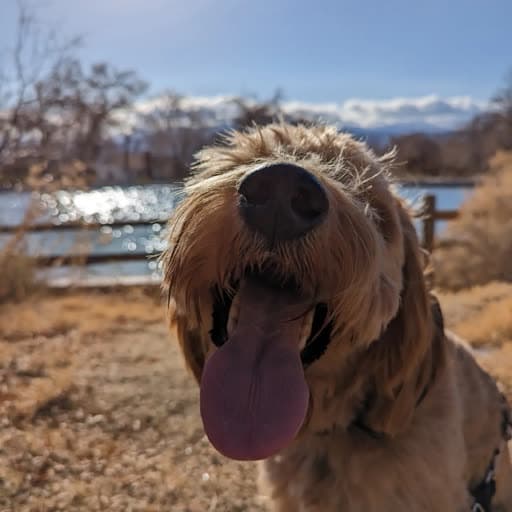
The three main Goldendoodle coat types
Every Goldendoodle coat falls into one of three categories. The differences are visible, feel different to the touch, and have real consequences for day-to-day care.
Flat coat (straight)
The flat coat looks closest to a purebred Golden Retriever. It lies flat against the body, has minimal wave, and tends to be denser and coarser than the other types. Flat coat Goldendoodles are more common in F1 litters where the Golden Retriever genes dominate. They are the lowest maintenance coat to groom but they shed the most, sometimes nearly as much as a purebred Golden.
Flat coats do not have the signature Teddy Bear look most people associate with Goldendoodles. If shedding is a dealbreaker, a flat coat is the wrong match.
Wavy coat (fleece coat)
The wavy or fleece coat is the most common Goldendoodle coat type and the one most people picture. It has loose, flowing waves, a soft texture, and the rounded muzzle that earns the Teddy Bear nickname. It sits between flat and curly in both shedding level and grooming demands.
Wavy coats shed very little compared to flat coats but they are not no-shed. Loose fur stays in the coat rather than falling onto furniture, which means regular brushing pulls it out before it escapes. Without consistent brushing, that trapped loose fur becomes the core of a mat.
Mango is F1B and has a wavy fleece coat. His fur does not end up on the couch or on clothing. But he gets brushed every 2 to 3 days and visits the groomer every 6 to 8 weeks. That routine is non-negotiable for a coat like his.
Curly coat
The curly coat looks closest to a Poodle. Tight ringlets or dense spirals cover the body, and the coat grows continuously rather than shedding out. It is the lowest-shed coat type of the three and the one most often associated with allergy-friendliness in marketing.
Curly coats require the most maintenance. Because the hair grows continuously and does not shed, it mats faster and more severely than any other coat type. Daily brushing is the floor, not a suggestion. Professional grooming every 6 to 8 weeks is essential to keep the coat at a manageable length. Owners who skip grooming appointments often face full-body shave-downs.
What causes each coat type
Coat type is determined by two genes: the KRT71 gene (which controls curl) and the RSPO2 gene (which controls furnishings, meaning the beard and longer facial hair). The balance between Golden Retriever and Poodle DNA in a given dog determines which version of each gene it expresses.
F1 Goldendoodles (50 percent Golden Retriever and 50 percent Poodle) can land anywhere on the spectrum. Many are wavy, some are flat, and a few are curly. The outcome is genuinely unpredictable at the breeding level for F1 litters.
F1B Goldendoodles (75 percent Poodle and 25 percent Golden Retriever) are much more likely to land in the wavy or curly range. The heavy Poodle genetics make flat coats rare in F1B litters. Multigeneration Goldendoodles, bred specifically for coat predictability, allow breeders to select consistently for wavy or curly outcomes.
Coat type and shedding
Shedding level follows a clear pattern across coat types. Understanding this before bringing a dog home saves a lot of frustration.
| Typical generation | Shedding level | Grooming frequency | Matting risk | Allergy-friendliness | |
|---|---|---|---|---|---|
| Flat (straight) | F1, occasionally F1B | High. Seasonal blowouts and year-round shedding similar to a Golden Retriever. | Every 4 to 6 weeks brushing. Professional groom every 8 to 12 weeks. | Low to moderate. The flat texture tangles less than curly but still knots at friction points. | Least favorable. Higher shed and dander release into the environment. |
| Wavy (fleece) | F1, F1B, multigen | Low. Loose fur stays in the coat rather than falling. Minimal furniture impact. | Every 2 to 3 days brushing. Professional groom every 6 to 8 weeks. | Moderate to high. Waves create catch points for loose fur. Armpits and ears mat quickly. | Favorable. Low shedding reduces airborne dander significantly. |
| Curly | F1B, multigen | Very low to none. Hair grows continuously and rarely sheds. | Daily brushing. Professional groom every 6 to 8 weeks without exception. | Very high. Dense spirals mat at skin level quickly. Missing a week causes problems. | Most favorable of the three. Least environmental allergen spread. |
How to predict coat type in a puppy
Breeders and experienced doodle owners use a few observable clues at 6 to 8 weeks to make an educated guess about adult coat type. No method is perfectly reliable, but muzzle furnishings come close.
| What to look at | What it means | |
|---|---|---|
| Muzzle furnishings (beard) | A visible beard and longer hair around the muzzle at 8 weeks strongly predicts a wavy or curly adult coat. A smooth, flat muzzle like a Golden Retriever puppy predicts a flat adult coat. | |
| Face shape | A rounded, fluffy face with defined eyebrow tufts suggests a furnished coat and a wavy to curly adult result. | |
| Puppy coat texture | Soft, loose waves at the shoulders and down the back at 8 weeks often indicate an adult wavy coat. Tight kinks or spirals suggest curly. A straight, smooth coat across the back suggests flat. | |
| Parent coat types | If both parents have known coat types from previous litters, a good breeder can predict the distribution of coat outcomes in the litter with reasonable accuracy. | |
| Generation | F1B and multigen puppies from Poodle-heavy pairings are highly unlikely to produce flat coats. If you specifically want a flat coat, an F1 litter is the better source. |
Grooming requirements by coat type
Grooming demands scale with how much Poodle is in the coat. The curlier the coat, the more work it requires to stay healthy and tangle free.
Flat coat grooming
Flat coat Goldendoodles are the easiest to groom but the hardest to live with if shedding bothers you. Weekly brushing with a slicker brush and a metal comb handles most maintenance. Professional grooming every 8 to 12 weeks keeps the coat trimmed and clean. The trade-off is visible fur on clothing, furniture, and floors year-round.
Wavy coat grooming
Wavy fleece coats need brushing every 2 to 3 days to prevent mats from forming at the skin. The loose fur that does not shed out gets caught in the waves and compacts into tangles at friction points: behind the ears, in the armpits, around the collar, and at the base of the tail. Professional grooming every 6 to 8 weeks keeps the length manageable and clears any mats that slipped through at home.
Mango is on a 6 to 8 week professional groom schedule. Between appointments, he gets a full brush session every two to three days using a slicker brush and a metal comb check. Skipping even four or five days shows up as small tangles behind his ears first.
Curly coat grooming
Curly coats are the highest maintenance by a significant margin. The continuously growing hair mats at the skin level and the tight spiral structure holds tangles invisibly below the surface layer. Daily brushing with a slicker brush, followed by a full metal comb check to confirm you reached the skin, is the minimum. Professional grooming every 6 to 8 weeks is not optional. Owners who stretch appointments to 10 or 12 weeks frequently arrive at the groomer with coats that require a full shave-down rather than a trim.
Which coat type is right for your household
There is no universally best coat type. The right answer depends on your priorities.
If shedding and allergens are the primary concern, a wavy or curly coat from an F1B or multigen line is the safest choice. If you want low grooming time and do not mind vacuuming, a flat coat from an F1 litter is easier to maintain. If you want the classic Teddy Bear look with a manageable brushing schedule, the wavy fleece coat hits the middle ground.
Whatever coat type you choose, build the grooming routine before you bring the dog home. The number one reason doodles end up in a shave-down at the groomer is not the coat itself. It is owners who underestimated the time commitment and fell behind on brushing. The coat is manageable when the routine is consistent.
Frequently asked questions
What coat types do Goldendoodles have?
Three: flat (straight), wavy (fleece), and curly. Wavy is the most common and the most associated with the Teddy Bear look. Flat looks more like a Golden Retriever. Curly looks more like a Poodle.
Is a wavy or curly coat better for allergies?
Neither is truly hypoallergenic. Curly coats trap more dander in the coat and release less into the environment, which can help mild allergy sufferers. Wavy coats are a close second. Flat coats shed the most and spread the most allergen. Spending time with the specific dog before committing is the only reliable allergy test.
How can you tell what coat a Goldendoodle puppy will have?
Look at muzzle furnishings at 6 to 8 weeks. A visible beard and fluffy face predict a wavy or curly adult coat. A smooth flat muzzle predicts a flat coat. Coat texture at the shoulders gives additional clues. Generation also matters: F1B and multigen puppies are very unlikely to grow flat coats.
Do flat coat Goldendoodles shed?
Yes. Flat coat Goldendoodles shed significantly more than wavy or curly coats. The flat coat behaves more like a purebred Golden Retriever coat with seasonal blowouts and consistent year-round shedding. Expect fur on furniture and clothing.
Which generation has the curliest coat?
F1B (75 percent Poodle) and multigenerational Goldendoodles bred toward Poodle genetics are most likely to produce curly coats. F1 Goldendoodles can go curly but most land in the wavy range. If you want a reliably curly coat, an F1B or multigen from an experienced breeder who selects for coat type is the most predictable option.