F1B Goldendoodle: everything you need to know
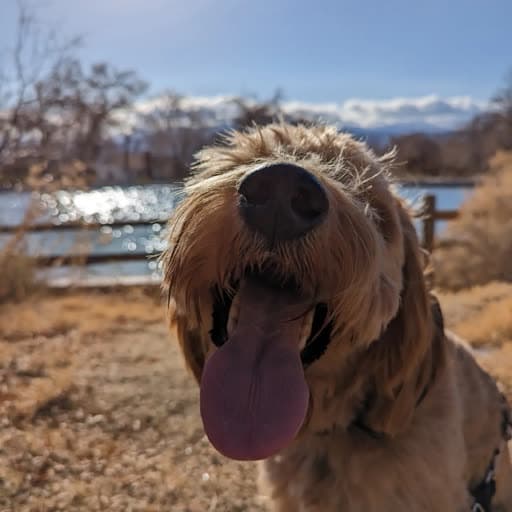
F1B is the most popular Goldendoodle generation for a reason. The 75% Poodle genetics produce the low shedding, allergy friendly coat that most doodle owners are looking for. Mango is an F1B. Here is what that actually means and what to expect.
What F1B means
The generation code tells you the breeding history of the dog. F stands for filial generation. The number indicates how many generations removed from the original parent breeds. The B indicates a backcross to one of the parent breeds.
An F1 Goldendoodle is a direct cross between a Golden Retriever and a Poodle (50% each). An F1B takes that F1 dog and breeds it back to a Poodle. The math: the F1 contributes 50% of its genetics (which are already 50/50), and the Poodle contributes 50%. The result is 75% Poodle and 25% Golden Retriever.
| Generation | Golden Retriever % | Poodle % | Produced by | |
|---|---|---|---|---|
| F1 | 50% | 50% | Golden Retriever x Poodle | |
| F1B | 25% | 75% | F1 Goldendoodle x Poodle | |
| F1BB | 12.5% | 87.5% | F1B Goldendoodle x Poodle | |
| F2 | 50% | 50% | F1 Goldendoodle x F1 Goldendoodle | |
| F2B | 37.5% | 62.5% | F1 Goldendoodle x F1B Goldendoodle | |
| Multigen | Varies | Varies | Two Goldendoodles, at least one multigen parent |
F1B coat
The F1B coat is the main reason this generation is so popular. With 75% Poodle genetics, most F1Bs inherit a curly to wavy coat that sheds significantly less than an F1. The coat tends to be denser and more uniform than an F1, with fewer dogs producing the straight, flat coat that is common in some F1 litters.
The trade off is grooming. A curlier coat mats faster than a wavy or straight coat. F1B Goldendoodles need brushing three to four times per week, professional grooming every six to eight weeks, and more attention to the mat hotspots (behind ears, armpits, collar zone, base of tail).
Coat color fading is also more pronounced in F1Bs due to the higher Poodle percentage. The fading gene is a Poodle trait and the more Poodle genetics a dog carries, the more likely it is to lighten significantly from puppy to adult.
F1B temperament
F1B Goldendoodles have the same core temperament as all Goldendoodles: friendly, affectionate, social, and eager to please. The additional Poodle genetics do produce some consistent differences from F1s.
Poodles are working dogs with high intelligence and a focus drive that can tip into anxious or restless behavior without adequate stimulation. F1Bs tend to be slightly more alert, slightly more independent in problem solving, and more prone to separation anxiety than F1s. This is not universal but it is a pattern that experienced Goldendoodle owners notice.
Training is generally easier with an F1B because the Poodle intelligence is dialed up. They pick up commands faster, retain training longer, and respond well to positive reinforcement. The flip side is they also learn bad habits faster.
F1B vs F1: which to choose
| Factor | F1B (75% Poodle) | F1 (50% Poodle) | |
|---|---|---|---|
| Shedding | Very low to none | Low to moderate | |
| Allergy friendliness | Best for allergy households | Good, not as consistent | |
| Coat texture | Curly to wavy, denser | Wavy to loose, softer | |
| Grooming frequency | 3 to 4x per week | 2 to 3x per week | |
| Coat fading | More likely to lighten with age | Less likely | |
| Trainability | Slightly higher | High | |
| Energy level | Moderate to high | Moderate | |
| Separation anxiety risk | Slightly higher | Moderate | |
| Cost | Typically similar or slightly higher | Baseline |
F1B size
F1B size is determined by the Poodle used in the backcross. If a Standard Poodle is used, the F1B is a standard size Goldendoodle (typically 45 to 75 lbs). If a Miniature Poodle is used, the F1B is a mini (typically 15 to 35 lbs). This is why an F1B Mini Goldendoodle tends to run smaller and more consistently sized than an F1 mini.
Mango is a medium F1B at 45 lbs, produced from a Standard Poodle backcross.
F1B health
F1B Goldendoodles benefit from hybrid vigor, the genetic diversity advantage that typically makes crossbred dogs healthier than purebred dogs from lines with limited gene pools. However, the main health considerations for Goldendoodles apply to F1Bs as well: hip and elbow dysplasia, progressive retinal atrophy (PRA), and von Willebrand disease (vWD).
Reputable F1B breeders test both parents: the Poodle parent for genetic conditions common to Poodles (PRA-prcd, PRA-rcd4, neonatal encephalopathy, sebaceous adenitis) and the Golden Retriever parent for hip and elbow dysplasia and heart conditions. Ask for OFA and genetic test documentation before committing to a puppy.
F1B cost
F1B Goldendoodles from reputable, health tested breeders typically cost $1,800 to $3,500. The price range is similar to F1s from the same quality tier of breeder. F1Bs with extensive genetic testing, health guarantees, and documented breeding programs can push toward $4,000 or more in high demand markets.
Be cautious of F1B puppies priced significantly below market rate. The genetics cost nothing to claim. Health testing documentation is what separates responsible breeders from mills.
Is F1B right for you?
Choose an F1B if you have mild to moderate dog allergies, want the lowest possible shedding in a Goldendoodle, are prepared for a grooming commitment, and want a highly trainable dog. F1B is the most popular Goldendoodle generation for good reason.
Consider an F1 if you prefer a softer, more predictably wavy coat, want slightly less Poodle energy intensity, or have children who will be doing much of the brushing (wavy coats are easier to maintain). If allergies are not a concern, the F1 temperament and coat texture work beautifully.
Frequently asked questions
What does F1B Goldendoodle mean?
F1B means first generation backcross. An F1 Goldendoodle bred back to a Poodle, producing a dog that is 75% Poodle and 25% Golden Retriever.
Do F1B Goldendoodles shed?
Very little. F1B is the lowest shedding Goldendoodle generation. Most F1B owners find almost no loose hair. No dog is completely shed free.
Is F1B better than F1?
Better for allergy households and low shedding. F1 has a softer coat and slightly calmer energy. Neither is objectively better. It depends on what you need.
Are F1B Goldendoodles hypoallergenic?
No dog is truly hypoallergenic but F1B is among the best options for allergy sufferers. Most people with mild to moderate dog allergies tolerate F1B Goldendoodles well.
How big do F1B Goldendoodles get?
Depends on the Poodle used in backcross. Standard F1B: 45 to 75 lbs. Medium: 30 to 50 lbs. Mini F1B: 15 to 35 lbs.
How much does an F1B Goldendoodle cost?
$1,800 to $3,500 from reputable health tested breeders. Similar to F1 pricing from comparable quality breeders.